(Hi, I’m Aditya Navin, and this is an excerpt from The Doodler, an art magazine of which I am the head and the editor-in-chief. This is an article written by me.)
Love. All humans crave it. It exceeds the borders of culture, and language, manifesting in countless forms yet remaining understood. Yet few paintings have managed to capture this fundamental human emotion as magnificently as Gustav Klimt’s The Kiss.
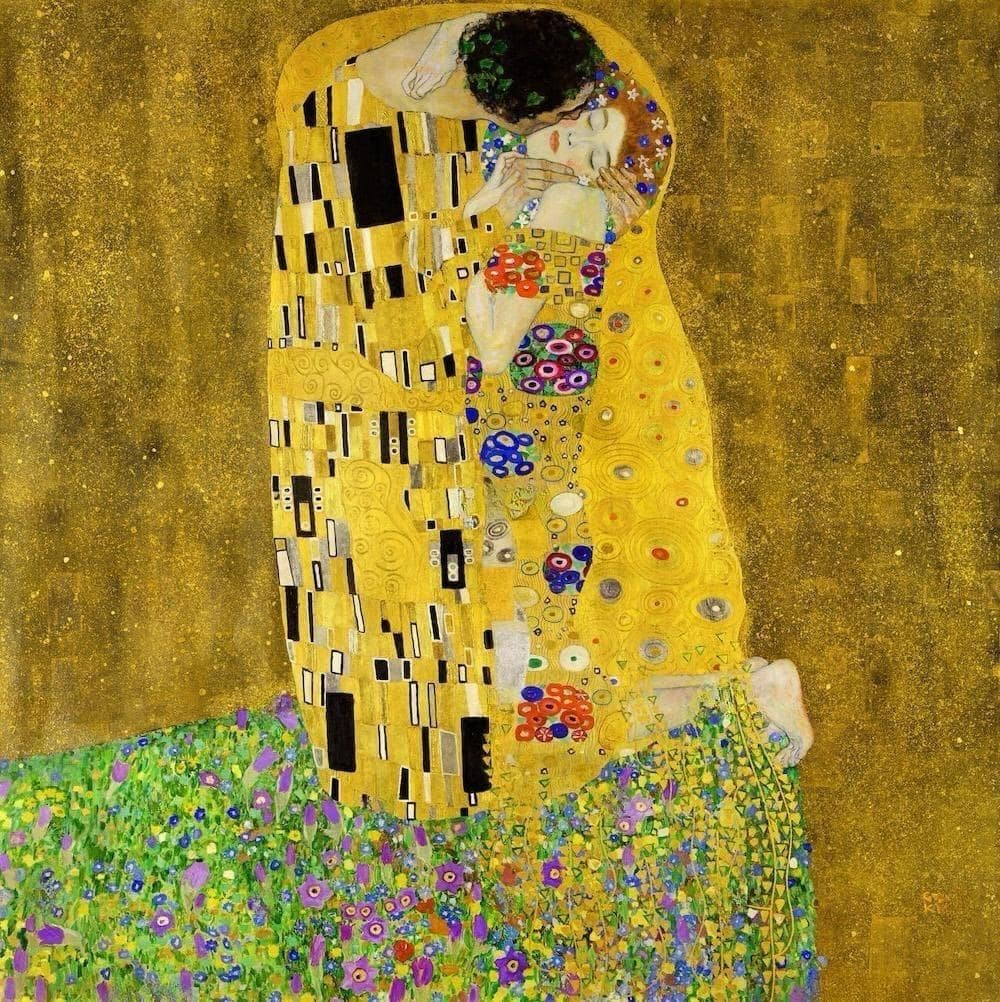
The Kiss is widely recognized as one of the greatest paintings of all time. Critics often regard it as the “magnum opus” of Klimt’s oeuvre. Rendered in oil on canvas with gold, silver, and platinum leaf, the painting depicts a couple closely bound in an embrace. Richly decorated robes, flowers in their hair, a woman’s eyes closed in delighted bliss – Klimt’s painting seems to be the very epicentre of intimacy. In the painting, the man is bending down, tenderly holding the woman’s face as he kisses her cheek. The woman, kneeling, tilts her head back, eyes closed, portraying serenity and even surrender. Their physical forms are subtly suggested rather than explicitly detailed, giving the impression that they are fused with their surroundings.
In terms of form and style, The Kiss is similar to a collage. Klimt is known as an innovator who used a variety of materials and styles in his work – in The Kiss, there is an extensive use of gold leaf. The Kiss was painted during Klimt’s “Gold Period”, where he heavily incorporated gold leaf into his works. Klimt’s father was a goldsmith, and the use of gold leaf contributed to his familiarity and appreciation for the material. Klimt also used silver and platinum leaf. These lavish materials were used to endow the subjects with a divine quality. Klimt primarily used oil paints in his paintings, and The Kiss is no different.
While The Kiss does not explicitly depict a myth, it can be interpreted as an allegory for the Greek legend of Orpheus and Eurydice. Orpheus, a gifted musician and poet, falls deeply in love with Eurydice. After their marriage, she is tragically bitten by a snake and dies. Heartbroken, Orpheus journeys to the Underworld, where his music moves Hades and Persephone to grant Eurydice’s return under one condition: Orpheus must not look back at her until they have both exited the Underworld. However, overcome with doubt and longing as they near the surface, he turns to look, breaking the pact. Eurydice is pulled back into the Underworld forever, leaving Orpheus devastated.

At first sight, I thought the woman was in joy, smiling in this euphoric moment. But upon closer inspection, I noticed she had a rather blank expression, similar to an unconscious person. There is something dominant about the male figure in The Kiss—he seems almost subduing and overwhelming. There is a certain power in the way he clasps his hands around her neck and body. On the contrary, the woman seems pitiful, even powerless. However, the most defining feature of the struggle between the man and the woman is how the woman holds the man’s hand. Is she holding his hand, or trying to push it away?
But remember, interpretation is optional, not required, for the audience. Sometimes the best appreciation of art is simply not to think too hard about what something means. It’s often best to stick with the observable, like the environment the gilding brings to life around the lovers. And remember that many artists get a real kick out of the over-the-top interpretations others project onto their work. We at The Doodler believe that sometimes, the best art shouldn’t be interpreted – it should be felt, seen and heard.
Maybe that’s what this piece is supposed to be. Simply appreciation of love.
 ADITYA NAVIN
Leave a comment